


Technical parameters
1. Basic parameters of safety cabinet:
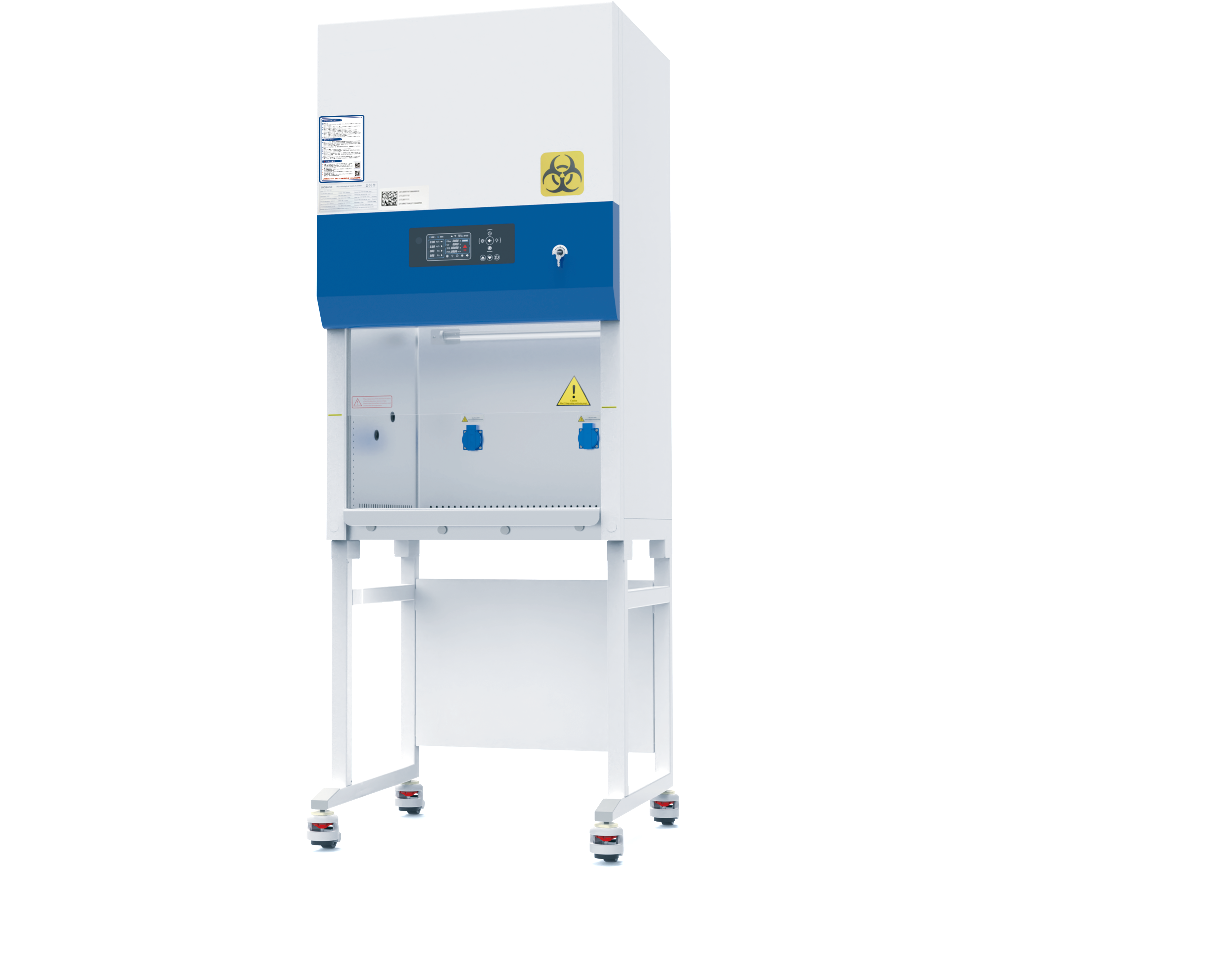
(1) Classification: Type A2, 30% efflux, 70% recycling;
(2) External dimensions ≥ (L×D×H) 700mm×650mm×1920mm;
(3) Internal dimensions ≥ (L×D×H) 600mm ×500mm×540mm;
(4) Height of countertop from the ground: 750mm (the height can be customized and modified according to requirements);
(5) Wind speed: average descending wind speed: 0.33±0.025m/s; average suction inlet wind speed: 0.53±0.025m/s;
(6) Total exhaust air volume of the system: 230 m³/h;
(7) Rated power: 1300VA (including the load of the operation area socket, with the total load not exceeding 1000VA, and the power of a single socket **500VA);
(8) Noise level: ≤67dB(A);
(9) Lighting: ≥1000 lx;
*(10) Filtration efficiency: Both the supply air and exhaust air filters utilize ULPA high-efficiency filters made of borosilicate glass fiber from a world-renowned brand, achieving a filtration efficiency of ≥99.9995% for particles of 0.12μm;
(11) Registration certificate number: CFDA Approval 20203220841;
(12) Weight: Paper packaging gross weight 141KG (with base);
(13) Number of users: Single person.
2. Biological safety:
(1) Personnel safety: Using the potassium iodide (KI) method for testing, the protection factor of the front window operation port should not be less than 1×10⁵;
(2) Product safety: bacterial count ≤ 5 CFU per instance;
(3) Cross-contamination safety: bacterial count ≤ 2 CFU per instance.
Structural and functional characteristics:
1. Jinan Xinbeixi Biotechnology Co., Ltd. is one of the drafting units for the product standard of Class II Biological Safety Cabinets (YY0569-2011) in the pharmaceutical industry of the People's Republic of China. Its safety cabinets comply with both the industry standard YY0569-2011 for Class II Biological Safety Cabinets and the national standard GB 41918-2022 for Biological Safety Cabinets;
*2. The cabinet adopts a vertical straight-face design, featuring small external dimensions and light weight, making it suitable for use in experimental settings with limited space;
3. The three side panels of the exposed working area of the safety cabinet are made of high-quality 304# stainless steel with an integrated structure. The parts inside that can be cleaned feature 8mm large fillets, leaving no dead spaces and making them easy to clean;
4. The working area adopts a negative pressure surrounding design on all four sides (left and right sides, rear, and bottom) to provide better protection and safety;
5. The workbench surface is made of high-quality 304# stainless steel and designed in a basin-like shape, ensuring that even if waste liquid overflows during experiments, it will not flow into the liquid collection tank, making it easy to clean;
*6. Formaldehyde cabinet caster design: The caster and bracket are designed integratively, allowing the safety cabinet to be safely moved via the caster, and also allowing it to be fixed and leveled by adjusting the caster legs;
7. The cabinet body and bracket can be separated, and the height of the bracket can be customized and modified according to the actual situation;
8. Reasonable structural design: The maintenance and replacement of the safety cabinet's filter and fan can be carried out from the front side of the cabinet, allowing for one-person replacement, which is more efficient; the four cushion blocks at the bottom of the cabinet reserve space for lifting, making handling safer and more convenient;
*9. The front window glass adopts double-layer laminated explosion-proof safety glass; even if the glass is damaged, it will not hurt people, and the biosafety cabinet can still work normally until the end of the experiment, providing better protection for personnel and experimental safety;
*10. LCD color display screen, full parameter display, real-time dynamic display of the descending airflow velocity and inflow airflow velocity in the operation area, display of the overall operation time of the safety cabinet, operation time of the UV lamp, temperature and humidity in the operation area, resistance of the air supply and exhaust filters, display of the filter usage time and the filter's service life displayed by a barcode, with all barcodes illuminated indicating the filter's service life has expired, and all operating statuses displayed at a glance;
*11. The glass door can be flexibly controlled by three methods: foot-operated, button-operated, and remote-controlled. When the glass door reaches the safe operating height, it will automatically stop lifting or lowering, making operation more convenient. Additionally, there is no need to directly touch the glass when lifting or lowering it, ensuring greater safety for experimental personnel;
12. Remote control: All button operations of the safety cabinet can be achieved through remote control, making the use of the safety cabinet more efficient and convenient. Furthermore, the use of the remote control greatly reduces direct contact between the user and the safety cabinet, providing better protection for the user's personal safety;
13. Equipped with a preset timing function, it can automatically set the timing for the safe cabinet to power on and off, as well as the UV lamp disinfection time, greatly saving work time and improving work efficiency;
14. Strict air tightness testing: Apply a pressure of 500Pa inside the safety cabinet and maintain it for 10 minutes, ensuring that the pressure does not drop below 450Pa;
15. Front window airflow barrier design: Prevents airflow leakage through the side walls and upper side of the front window, ensuring safer testing;
16. Selection of excellent fans: When the safety cabinet is operating normally without adjusting the speed control of the fan motor, and the air pressure drop through the filter is 50%, the decrease in exhaust volume of the fan should not exceed 10%;
17. Perfect alarm system:
(1) Alarm when glass door is not at safe height: The safe height of the glass door is 200mm. When the front side of the safety cabinet is higher or lower than the safe height, the safety cabinet will give an audible and visual alarm;
(2) Filter pressure ultra-high alarm: When the resistance of the filter increases, the safety cabinet will give an audible and visual alarm;
(3) Filter replacement alarm upon failure: When the filter reaches the end of its lifespan, an audible and visual alarm will sound for filter replacement;
(4) Airflow fluctuation alarm: When the airflow fluctuation of the safety cabinet exceeds 20% of the nominal value, an audible and visual alarm will be triggered.
18. Safe interlock protection design: Interlock protection is set for all misoperations, ensuring that even if there is a misoperation, no harm will be caused
(1) Interlock between safety cabinet fan and glass door: When the glass door of the safety cabinet falls to the bottom, the fan automatically shuts down, further protecting the use of the safety cabinet and extending its service life;
(2) Interlocking between UV lamp and safety cabinet glass door, fan, and lighting: The UV lamp can only be turned on when the glass is fully lowered and the lighting is not turned on, preventing accidental operation of the UV lamp that could cause harm to the human body and further ensuring personnel safety;
*19. The double trigger signal for closing the front window enables the ultraviolet lamp to normally activate its sterilization and disinfection function;
*20. The negative pressure duct is equipped with a foreign matter filtering structure to prevent paper scraps and other foreign objects from entering the fan system and affecting the normal operation of the product.